
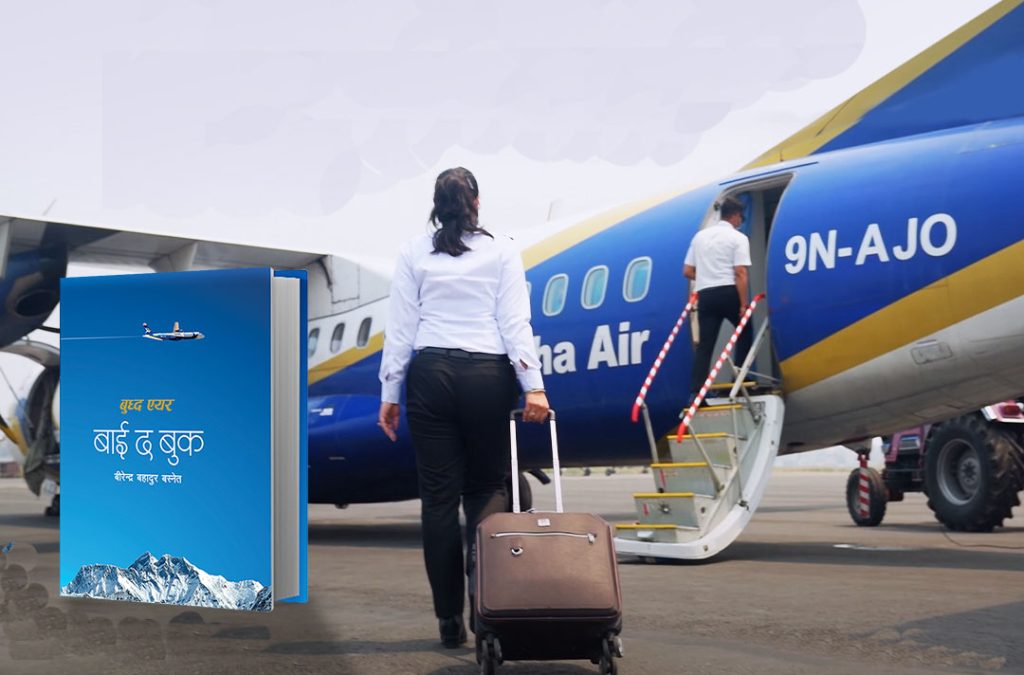
In an age where deepfake videos flood social media, showing apparently absurd scenes such as luggage tied to aircraft roofs or passengers boarding flights with goats and chickens, their pure fiction is easily dismissed. Ironically, some of these AI-generated fantasies echo real episodes from Nepal’s aviation past.
As the author Hemant Mishra remembers in In the Service of His Majesty, it was a common sight in the 1970s to carry goats along with other livestock while flying from Butwal to Mahendranagar. The Nepali aviation sector has since covered a long distance-from Dakota aircraft used to drop revolutionary leaflets in 2007 BS (1950-51 AD) to today’s modern fleet of turboprops. It is this journey that Birendra Bahadur Basnet’s book so eloquently captures, blending his personal memories with broader reflections of growth, struggles and contradictions of Nepali aviation.
Basnet, founder of Buddha Air, attributes the airline’s success to hard work, ambition, and a fair share of luck – often framed through the lens of fate and karma. He credits much of the company’s early momentum to his brother Shivendra, a pilot whose career shift drew the family into aviation. Without Shivendra, Basnet says, Buddha Air may never have gotten off the ground.
The story depicts how personal will and family bonding turned a humble start-up into the most dominant domestic airline in Nepal.
Competition and the “Koshi Opportunity”
The book captures in elegant detail the fierce competition that characterized Nepal’s aviation industry in its formative years. Cosmic Air, at one time a market leader, deployed sophisticated aircraft such as the Fokker 100 and Dornier 228, offering fares as low as Rs 1,100 on the Kathmandu–Biratnagar sector and even holding motorcycle lucky draws to woo passengers.
When Cosmic Air buckled under financial pressure, Buddha Air seized the opportunity by investing in ATR aircraft. A turning point came during the Saptakoshi floods, which severed road connectivity in eastern Nepal. With ground transport paralysed, air travel became indispensable, and the natural disaster had assumed the proportion of a decisive commercial advantage for Buddha Air. This anecdote explains how external crises reshape industries and reward preparedness and strategic foresight.
Navigating Crony Capitalism
Unusually, Basnet is candid about the entrenched “crony capitalism” of Nepal, where access to the right politicians and intermediaries usually makes all the difference. He described how even a key loan from the Bank of Ceylon came through only by using political leverage, for instance, depositing the Nepal Army Welfare Fund with the bank to smooth the approval process.
This no-nonsense conclusion is striking: it is all but impossible to start a large enterprise in Nepal without proximity to power. It is this honesty that puts a finger on the structural obstacles marginalising outsiders and reinforcing elite networks.
Internal Conflict and Sole Ownership
The book argues that ownership is the central factor that has helped Buddha Air survive while 36 other Nepali airlines failed as a result of disputes between partners. Even Buddha Air, however, hasn’t entirely avoided internal conflicts.
This led to a shareholding dispute between Shivendra and Birendra, with their niece Devyani going along with Birendra. The ultimate decision of the family council capped Shivendra’s family stake at 35%. Basnet provides an interesting parallel to the fall out between the Ambani brothers after Dhirubhai Ambani’s death, bringing in a vital fact: that even very successful family businesses are prone to fragmentation.
Strengths and Weaknesses of the Book
While Basnet emerges as an exciting character that management students often look up to, there are flaws in the book. This could have been more of a history of aviation in Nepal with discussions of carriers such as Necon Air that failed or competitors like Yeti Airlines. Instead, it remains very much personal.
Editing weaknesses further undermine the impact. Statistical errors (an exaggerated claim of Rs 1.71 trillion in VAT payments, probably meant to be billions), as well as typographical mistakes and inconsistency in tone, detract from its credibility. The book could have gone on to become an authentic reference book on Nepali aviation had it been better edited.
Looking Ahead The book concludes on a hopeful note with the Koshi Air project, a Public–Private Partnership to enhance provincial connectivity. Considering Basnet’s strong bias toward single ownership, it will be interesting to see how this shared model works out. Deepfakes,in sirened historical anecdotes, and entrepreneurial grit have been deliberately weaved together within Basnet’s account to create a revealing lens on the evolution of Nepal’s aviation. It is a discreet reminder that behind each today’s viral illusion has connected real stories about innovation, rivalry, and resilience that continue to take shape in the skies above the Himalayas.