
“The World Bank and the World Health Organization have commissioned a study that says ‘expenditure in the health sector is an investment that yields returns.’ Every dollar spent on nutrition education provides a return of 12.20 dollars,” say these studies. Do we have something similar in our own backyard that calculates the cost of our investment and the return that we receive? The return is certainly an important aspect in the American context where the government is investing over 80 dollars in each citizen, but in the Nepali context, the return is almost seventy-three percent lower with an investment of only 20 dollars. The return may be lower or the risk may be higher. What is the influence in the Nepali context?
The study, Swasparsha by Dr. Navaraj KC, does not focus on the economic data, but it offers a humane representation of the bleak reality.
Swasparsha is a collection of stories based on the pain and sufferings of the common man the author has witnessed during his medical practice. The author believes the book is a collection of stories of hopes, inspiration, and happiness. A medical practitioner by profession, the author has already started his journey in writing the book Sunyako Mulya (The Value of Zero).
“He treats the people who seek his medical expertise as ‘case studies.’” His patients are his data. Using qualitative analysis, he is able to lay bare the “condition of the health sector in remote regions.” His strength is in extending beyond merely medical expertise to examine the “economic conditions” of his patients and “the depths of sociology.”
“Cases” are continually questioning the extent of community understanding of health issues and the government’s expenditure in those areas. This book provides hope and motivation for dealing with serious mental issues of health. Cases under his consideration are taken from his patients, but conditions are also taken from non-patient individuals.
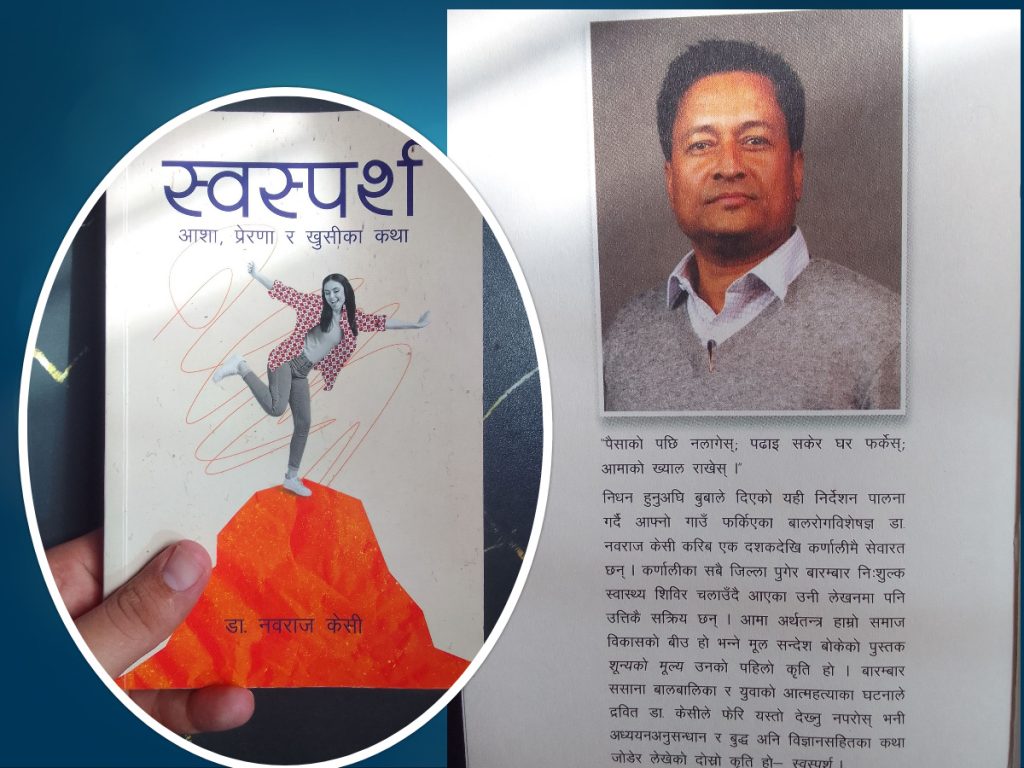
The book contains three chapters, each of which repeatedly moves readers’ emotions by reflecting on the public health situation in the country. Danger-causing traditions and social misconducts stir up one’s conscience. The application of a poetical format in scientific themes reaches one’s heart. It challenges one to question the government and its expenditure on prioritizing health, but even more so excites one in commitment for service and respect for a motivating individual.
Buddha, Science, and the Fool
A journalist from Jajarkot brings with him his younger brother, Jung Bahadur, who is brought to Dr. KC. He can neither walk nor move around properly because of the lack of treatment. After treatment, he sets off walking with his legs instead of his mother’s back. However, despite taking medicines for three months, he never comes back. The writer waits for him, only to find that the child is nowhere around. The journalist quits his follow-ups too; it is up to the doctor to dig into the truths about disability benefits from the government.
“Jung Bahadur is physically disabled, so he used to receive an allowance every year worth 40-45 thousand rupees, considering his disability. However, since he has started walking, he will receive less allowance per year.”
If Jung Bahadur is able to walk, then he will not receive his allowance. His family, having feared losing their income, stops his treatments. Writes Dr. KC, “A disabled child’s allowance in a faraway village of this country was being used as part of the father’s drinking expenditures by the family’s livelihood.”
The earthquake in Kartik 2080 (November 2023) brings the writer to Jajarkot. After much struggle, he reaches Jung Bahadur’s residence and hears the father’s story—selling goats, borrowing money, and being addicted to alcohol. The writer is moved by the plight of Jung Bahadur and his father’s inability to resist his son’s ill-treatment because of being indebted, addicted to alcohol, and waiting for help from the government following the earthquake.
With a story that begins with advising a teenager who has been found writing a suicide note, the author enters the “gymnasium of the human brain” to elucidate the concept of health science by connecting it to the turning of the Wheel of Dharma by the Buddha.
The experience of the beggar becoming a laborer through the change of his mental outlook greatly influences the reader. From this background, the author develops the topic of mental illness, self-control, and disciplined practice. B. P. Koirala’s idea of the “faulty lens” is used to describe the origin of anxiety and depression. The author designates the cycle of the faulty lens and prescribes the Eightfold Path of Buddha to overcome the cycle.
The capacity that Dr. KC has to outline the environments is amazing. While telling Mandire’s story, he goes ahead and describes his cut hands, torn caps, and looks. The picture he portrays does not give room for imagination—it is more like a snapshot. Mandire is always gathering empty bottles and paper from around the hospital. This is where philosophy crops up. Dr. KC explains, “‘In the true currency of human life, our poverty and wealth are almost the same.’” The habit that Mandire has of smiling during pain is so powerfully portrayed.
Though a doctor by training, Dr. KC is a very strong storyteller. He weaves theoretical segments seamlessly into storytelling. The ease with which he traverses the line between reality and story is such that he depicts emotions of the characters so effectively that one can’t help wondering whether it is a fiction or a non-fiction piece.
The author concludes that if in reality we calculate the actual wealth consumed by any living organism on the planet, then it would not mean much between the richest and the poorest.
Thank God Nature Does Not Charge us for Oxygen!
The second chapter begins in the form of question and answer, denoting that humans are born with society in their body. The experiences of human fears amid COVID-19 and the braveness of those who carried patients to hospitals are described. The statements of an elderly man carrying his wife, who was affected by COVID-19, to the hospital are very moving to the author. The elderly man says, “Nowadays people are lost, sir—everything has been divided into shares.”
The writer now calculates the cost of air that human beings breathe:
“COVID has shown us that an individual inhales an amount of air that can be satisfied by three oxygen cylinders a day. The price of each cylinder is 700 rupees. So, the cost comes to 2,100 rupees a day. This translates to 766,700 rupees a year. An individual who lives for 65 years will get about five million rupees of free oxygen,” he writes. “Thank God that nature doesn’t charge for that.”
In this respect, the author estimates life in terms of the lowest level measured in economics. The author thinks if real wealth is measured properly, then the difference between the rich and the poor won’t matter. The joy in pain gives him hope, and he finds solace in patients who bring color to life despite living in poverty.
Mental illness—one of the most problematic issues of this age—is dealt with in every chapter. “Depression” and “mindfulness” are keywords that are widely talked about around the world. These concepts are interpreted in the form of examples and theoretical explanations that can be grasped easily. There are also pictorial explanations available. The author finds the economics of happiness in the features of a little girl’s face:
The “love currency” which we attempt to buy is in reality the love which we give away,” he writes. “Today, I learned the secret of happiness economics from the face of a girl,”
The author has openly recognized himself as a poet through poems/poetic quotes presented in the book.
He points out that poems composed by writers who took their own lives have a higher incidence of “I, “ “me, “ and “my.” The rewards reaped by serving others are, instead, immeasurable, as can be gleaned below:
Accounting for Principal and Interest in Self-Building
The third chapter raises the question: How many handfuls of happiness does one receive in return—principal and interest—for having given only one handful of it to other people?
The experience of “Navaraj the Shepherd” and his fight against depression is very interesting. As Navaraj starts involving himself in rescuing deserted animals, his need for sleep pills ceases. Service becomes his self reconstruction. The author has exemplified this by stating that self-centered speech is common in all works of people who took their own lives, but service provides in return, priceless.
On a similar note, the story of Kiran Kishor Sapkota establishes that the mental weakness of a person can impede even able persons from doing what they want to do. For instance, Kiran is physically unable due to polio, but he wants to ride a bicycle and plant trees in The writing is not simply the opinions of the author. The characters’ voices come through. Each experience is different, but all lead to one conclusion: service is inspiring. The value of the story of the retired mother has to do with investments in children. It assesses not only the changes in the lives of the children, but also the returns the mother gets. To treat the matter of investment and returns simply based on the figures would be unfair, since the value of the internal happiness cannot be quantified. The book ends with the story of Asmita. From being from the Badi community to being on her own feet and helping others to achieve that has been her transformation. Her story is so motivational that it is difficult to draw comparisons. With Swasparsha, Dr. KC has demonstrated advancement from his first book, “Sunyako Mulya.” His writings have become more polished and mature. Dr. KC is a doctor, but he is a standout writer despite that. The reason for Dr. KC’s success is that he finds stories in people, relates it with the path taught by Buddha, and explains the economics of humanity.