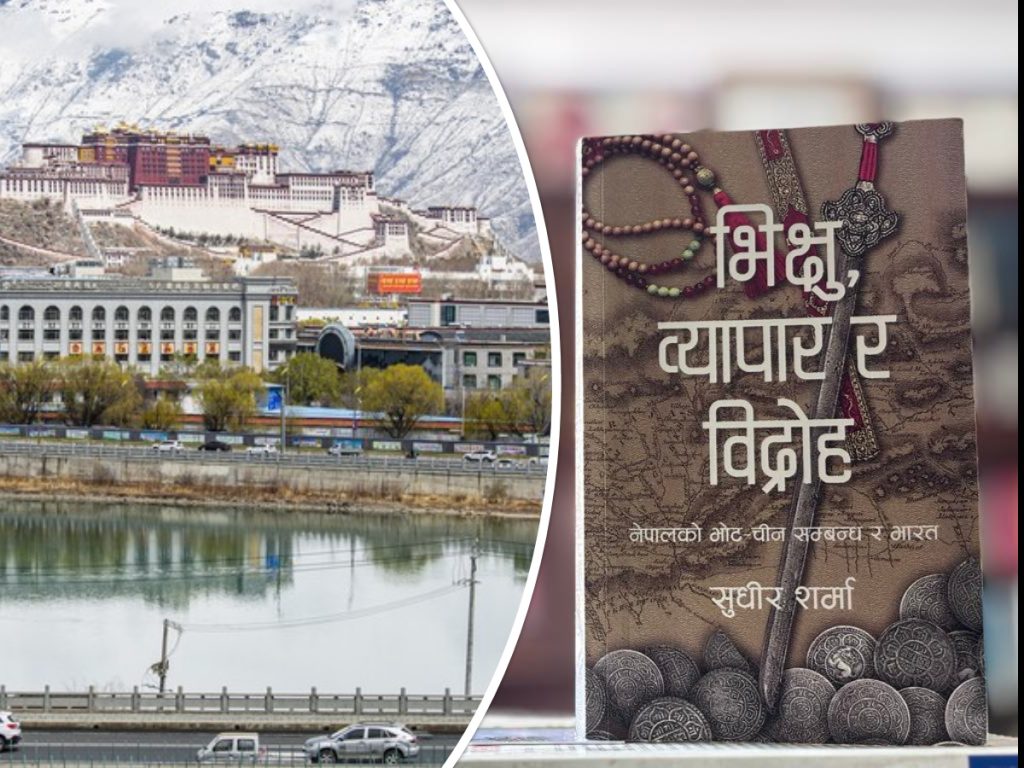
How did the Nepalese merchants, who at one time were the leading economic power in Tibet, manage to lose their identity as the “Marwaris of Lhasa” in the first place? This is what will be explored in Sudheer Sharma’s most recent book. This book sheds light on what can be considered a staggering historical fact: that there has been a business in the ownership of a Nepalese in Tibet for over a thousand years.
A 1961 (2018 BS) study validated that such ancient enterprises, mainly managed by the Newar traders, had reached such saturation levels that they were simply referred to as the ‘Marwaris’ of Lhasa, the capital of Tibet. The age-old ties between Nepal and the north, which have traditionally been referred to as Bhot, then Tibet, but are now known by the name Xizang, have always been rooted in two pillars: trade across the Himalayas, along with Buddhist ties.
The Relevance of Monks, Trade, and Rebellion
In “Bhikshu, Vyapar ra Vidroha” as the book is subtitled in Nepali, “Monks, Trade, and Rebellion,” the author Sudheer Sharma carefully unpacks the trade, diplomatic, and cultural aspects of this connection. Throughout the book, the writer spells “Hlasa” correctly to pay tribute to the proper way in which “Tibet” is pronounced in the Himalayan country. The story begins in the streets of Hlasa but ends in the Chinese capital of Beijing. It thus supplies readers with information about Chinese views about Nepal from a historical perspective.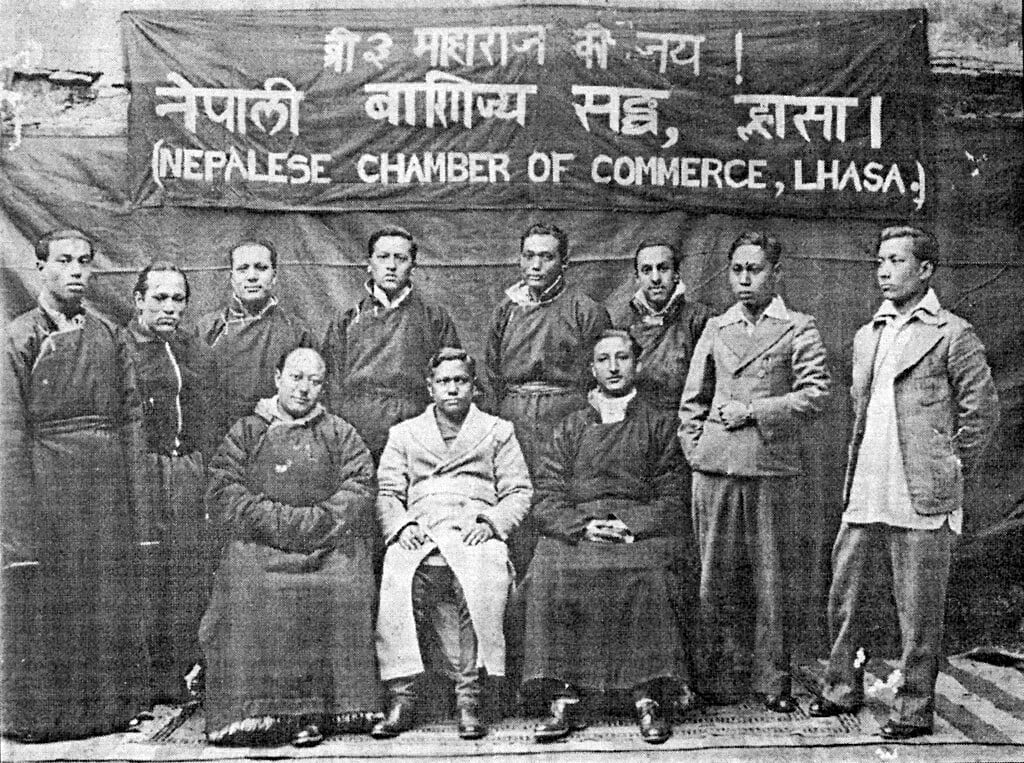
Until 1958 (2015 BS), Newar traders dominated Hlasa’s markets; all products, ranging from staple food grains to foreign luxury brands, were provided by Newars. Quoting scholar Rahul Sankrityayan, Sharma states that these people called ‘Marwaris’ had only one warehouse to store products worth millions of rupees.
The 1961 Chinese government survey uncovered the remarkable antiquity of these enterprises in Nepal:
One of these shops is over 1,000 years old!
There were 3 shops that ranged from 500 to 1,000 years old.
This cross-Himalayan wealth did not remain within the borders of Tibet, but also contributed to the grandeur of the Kathmandu Valley. Sharma also draws the reader’s attention to the technological superiority of the early Nepalis, for instance, they started producing paper in the 7th century, five centuries ahead of Europe.
Diplomatic Moves and the Great Game
Sharma examines how successive rulers in Nepal managed their complicated northern frontiers.
Chandra Shumsher: The series of events he was involved in include the résume of how he proved British concerns about Russian domination in Tibet, which in turn pushed Tibet away from Nepal and enabled the British to take the route to China via Sikkim.
The Betrawati Treaty: After the Nepal-Tibet-China War, this agreement contributed greatly towards shaping the present northern boundaries of Nepal.
King Mahendra: He is identified as the “architect of Nepali diplomacy” and has been very successfully placed in between India and China while incorporating some of the moves by Mao Zedong’s mobilization policy for his own purpose.
King Birendra: By contrast, Birendra is presented as more of a reactive foreign affairs man. His Chinese commitment was at times spurred by the ‘Sikkim Syndrome,’ which was a fear of Indian encroachment after Sikkim merged into India in 1975.
One of the most engrossing portions of this book is on the crafty blend of Buddhism and communism. The author traces the mental connections from Rahul Sankrityayan to Bhikshu Ashwaghosh to explain the germination of communism in several Nepali commerce men in Tibet. Moreover, this book strengthens the role of Nepal as the “civilizational bridge.” The Nalanda university in India significantly declined in those times. But then, the “Kathmandu Valley was to become the world’s main refuge in the preservation of Buddhist scriptures.” It was in this place that the “Vajrayana school was transmitted to Tibet through the legendary Padmasambhava (Guru Rinpoche).”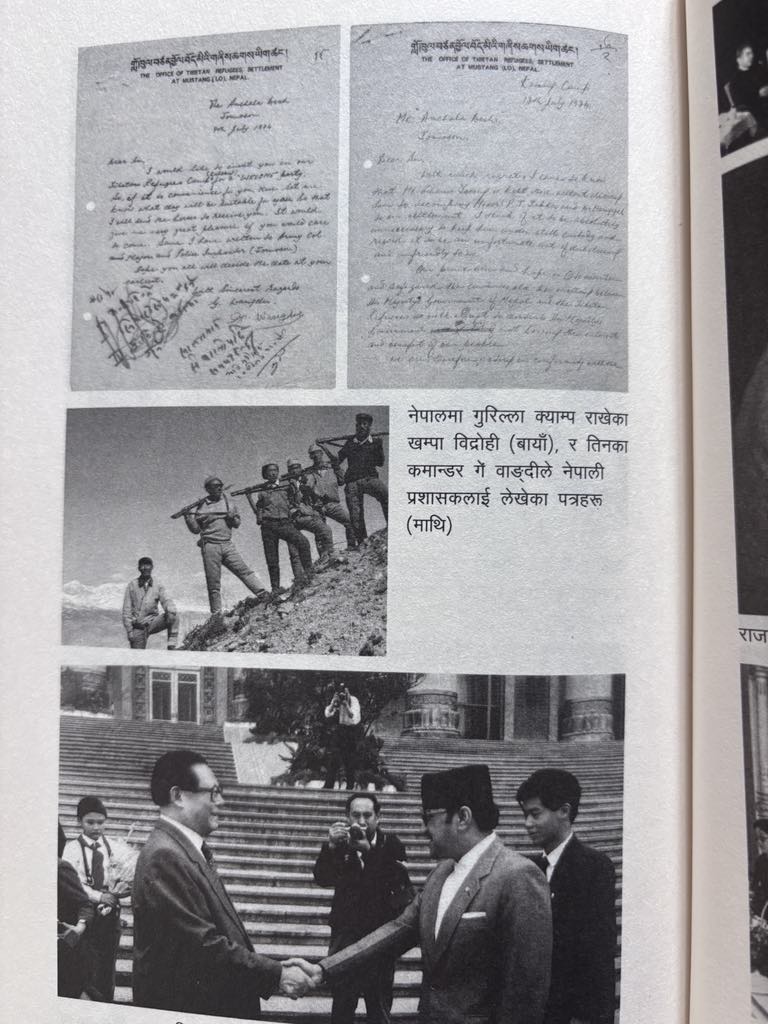
Khampa Rebellion to the Carpet Industry The book throws new light on the origins of the Tibetan carpet industry, which remains one of the country’s major export businesses to this day. This economic backbone was, in fact, a function of the failed Khampa rebellion. As the CIA and India lost interest in the rebels, this was inevitably followed by a CIA-sponsored resettlement program designed to provide employment for resettled Tibetans. The fact is, this major backbone of modern Nepali business is derived from Cold War era covert operations.
Methodology & Conclusion
As a seasoned journalist, Sudheer Sharma skillfully merges academic scholarship with investigative journalism. The book, laced with an impressive 85 pages of end notes and references, is a substantial historical record. At once a travelogue, political biography, and sourcebook for exclusive interviews conducted with past diplomats, ‘Bhikshu, Vyapar ra Vidroha’ is a must-read for all who seek to comprehend the complex, interlocking threads that have, for a thousand years, tied Nepal, Tibet, and China together.